
A Therapist’s Guide to Finding Your Niche (2026)
To find your niche as a therapist, use two approaches: identify which client group you most enjoy, are most effective with, and find easiest to work with ("Finding Your Flow"), or match your identity, lived experience, and clinical expertise to the client group you're best suited to help ("Finding Your Match"). A clear niche improves visibility in AI search tools, builds deeper expertise, and lowers burnout risk.

Niche /niːʃ/ noun A specialized segment of the market for a particular kind of service.
Many therapists who are starting out in private practice struggle over the vexed question of “the niche”.
Do you need to have a niche? And how do you go about discovering one?
In this post, I’ll share my thoughts on the benefits of having a niche and two approaches to finding yours.
The Niche Advantage
When you’re starting out, you may not have a clear idea what your niche is, and you may not feel you’re in a position to turn away any clients. And that’s OK. Most therapists find and refine their niche over time.
But having a niche has its advantages:

Improved Visibility: When you have a clear niche, you can be more focused in your branding and marketing efforts. More clients are using Gen AI like ChatGPT, Claude and Gemini (or Google AI mode) to find a therapist for their specific needs, and these tools will recommend therapists who appear to be experts in these areas.
Deeper Expertise: Seeing more clients in your niche builds experience and expertise. You can also be more targeted in your professional skills development.
Better Client Outcomes: As you build expertise, you’ll deliver better outcomes for your clients. Your risk of burnout will be lower as you’ll enjoy working with this client group.
Stronger Reputation: With greater expertise and better client outcomes, you’ll start to grow your reputation.
Quality Referrals: Satisified clients will tell their friends about you. Other therapists will refer more clients to you.
More Niche Clients: And all of the above means you’ll attract more clients, most of whom will be in your niche, and you’ll be able to reinvest in more targeted marketing.
“But I don’t want to turn away clients”
The main concern that therapists have when it comes to having a niche is that they don’t want to exclude client groups. But don’t forget:
You can have more than one niche.
You can change your niche or add another anytime.
Your niche doesn’t have to be exclusive.
It’s better to focus on what you’re good at.
Your niche will be where you focus your time, energy and marketing. But you can still be open to other groups of clients. In fact I think it’s healthy to have a mix of clients so that you keep learning and growing. You can aim for something like 80% niche and 20% other clients.
When you start focusing on your niche clients, it’s natural that you’ll have fewer non-niche clients. But over time, this should be more than offset by a new inflow of niche clients.
So how do you go about finding your niche?
Approach 1: Finding Your Flow
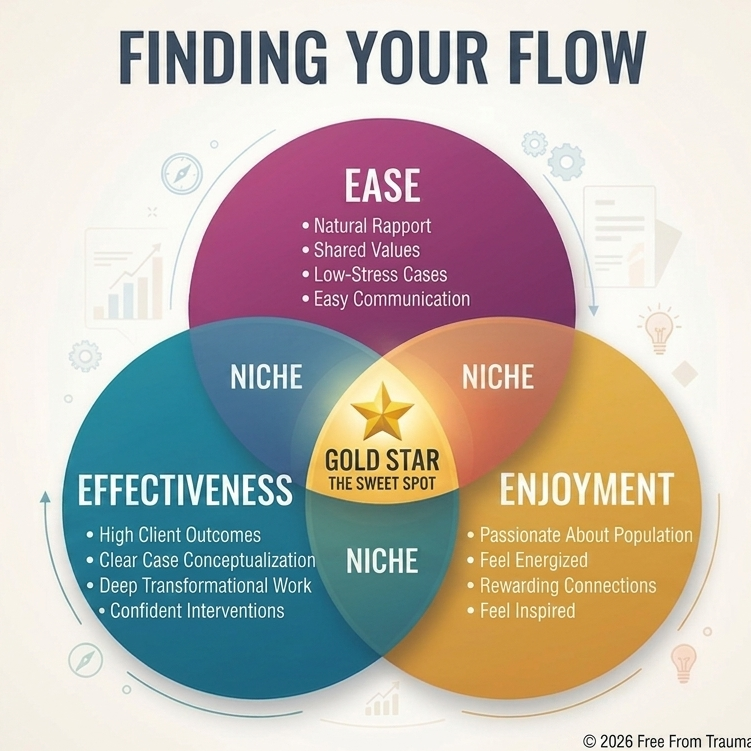
When you think about your past and current clients:
Which group of clients do you find it easiest to work with? Why?
Which group of clients are you most effective with? Why?
Which group of clients do you most enjoy working with? Why?
It may be helpful to also consider the opposite:
Which group of clients do you find it hardest to work with? Why?
Which group of clients are you least effective with? Why?
Which group of clients do you least enjoy working with? Why?
In the ideal world, your answers to the first three questions will be the same. Two out of three is great too.
But the clients you most enjoy working with may not be the easiest, and you may not enjoy working with the clients you’re most effective with.
If there’s a difference in your answers, I’d say that the most important question is which clients you most enjoy working with. This is the factor that will keep you from burning out, and keep your practice sustainable.
Don’t forget that you can always mix and match or have more than one niche. For example, 80% of your caseload can be the clients you most enjoy working with, and 20% can be others.
Approach 2: Finding Your Match
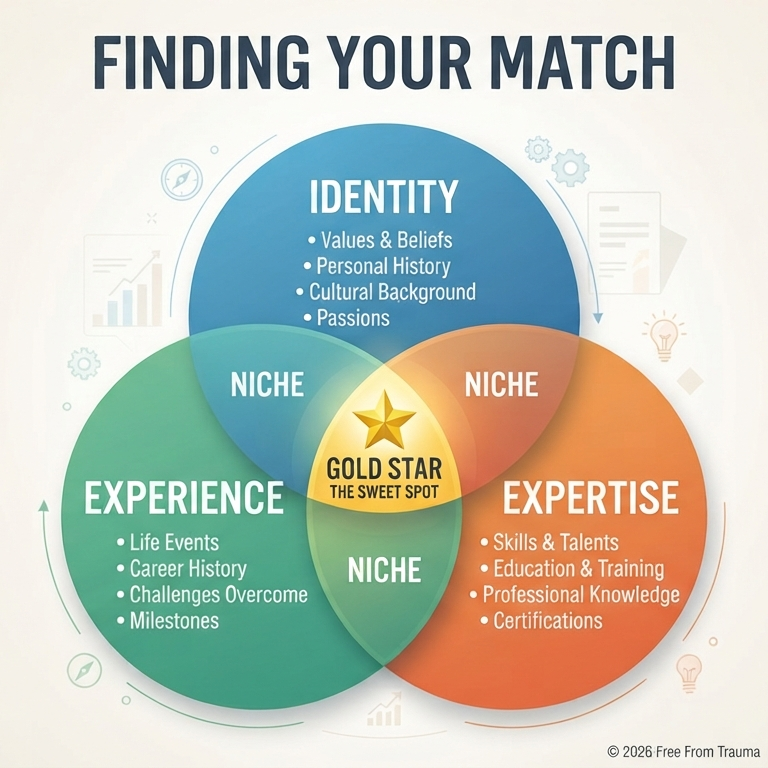
Perhaps you’re just starting out or you’re looking to work with a different group of clients. So here’s another approach.
Clients look for a therapist who can help them, which often boils down to three things:
“Can you understand me?” (Identity)
“Can you understand my issue?” (Experience)
“Can you help me?” (Expertise)
The more your identity, lived experience and expertise overlap with what a potential client is looking for, the more ideally suited you are to be their therapist.
Identity
Think about your own identity and background, such as your age, gender, nationality, ethnicity, faith, sexual orientation, disabilities, or medical conditions.
Obviously you don’t have to be the twin of your client to be able to help them. But we often gravitate towards people who are similar to us because we think they’ll be able to better understand us. We won’t have to explain so much.
Experience
Consider your life experiences, like which countries you’ve lived in, your work experience, and your relationship history.
Think about the challenges you’ve overcome, perhaps a difficult childhood, bereavement, divorce, redundancy, or physical or mental health issues.
Many clients want to work with a therapist who has gone through what they’re going through and come out the other side.
Expertise
Look at the modalities and approaches you’re trained in and enjoy using.
Some clients are looking for a specific approach or modality. If you have deep expertise in a particular modality or are trained in a rarer approach, this can help you decide which client group to focus on and how to market your services.
For example, I have expertise in MEMI (Multichannel Eye Movement Integration) and Brain-Switch 2.0, which were created for people dealing with trauma. They also work well for my therapist-clients as they’re content-free.
Conclusion
Burnout is a big issue for therapists. One of the factors is client-fit. You won’t enjoy your job if the majority of your clients are a poor fit for you.
Conversely, if you enjoy working with most of your clients and are able to help them effectively, you will feel motivated and energised in your role.
Also, with the thousands of therapists out there, focusing on your niche is the best way to stand out and be found by the clients who need the unique therapist that you are.
Get in touch
I hope you found this helpful. I’d love to connect with you on LinkedIn or Instagram, and feel free to get in touch if you have questions.

Eunice Tan
Trauma & Attachment Psychotherapist



Exposure therapy isn't the only option for treating a phobia. Here's a gentler, three-step approach that works with the memories driving your fear, without repeated exposure to the trigger, often in just one to three sessions.