MEMI (Multichannel Eye Movement Integration)

Older white man in a dark suit standing next to Asian woman in red jumpsuit and belt in front of a screen with the words MEMI Conference 2024 The Future of Trauma Therapy

With Dr Mike Deninger, Creator of MEMI, at the inaugural MEMI Conference in 2024

As a Certified MEMI Practitioner who specialises in MEMI, I’m proud to be a Founding Member of MEMI International Asia. I was Chair of the Organising Committee for the inaugural MEMI Conference in 2024. I love supporting the training of new MEMI practitioners by giving demos and sharing my experience.

The Creation of MEMI and Dr. Mike Deninger’s Most Memorable Cases

In this in-depth conversation with Dr. Mike Deninger, Creator of MEMI, we explore:

- Dr. Deninger's 20-year journey to creating MEMI

- His most memorable cases involving violent assault, a war veteran, his best friend's mother, and doing MEMI in a grocery store

- Why MEMI reduces therapist burnout

- The neuroscience behind MEMI

- Why MEMI can be used with your family and friends

- Why even Dr. Deninger experiences imposter syndrome

- Why MEMI empowers clients

- Dr. Deninger's hopes for MEMI

  • Dr. Mike Deninger: Breakthrough Stories from the Creator of MEMI Trauma Therapy

    [00:00:00]

    Introduction

    Eunice Tan: Hi, I'm Eunice Tan, Psychotherapist at my own practice, Free From Trauma. I help people heal from painful memories that affect their self-esteem, relationships, and careers, using techniques that are non-intrusive, non-triggering, and generally work in about one to three sessions. MEMI, Multichannel Eye Movement Integration, is one of my go-to techniques for trauma healing.

    I trained in it in August 2023, and even now I'm constantly amazed by how well it works for so many of my clients. I've had the privilege of meeting and working with Dr. Mike Deninger, the Creator of MEMI, and I was curious to ask him what are some of his most memorable stories from using MEMI. We had a wonderful conversation, which we recorded, and I'm so pleased to be able to share this with you. Enjoy.

     All right. Mike, I was going [00:01:00] to say good morning, but it's good afternoon for you and morning for me. But Mike, thanks so much for sitting down with me for this chat. I'm so glad we found the time to do this. I know how busy your schedule is.

    Mike Deninger: My pleasure.

    Eunice Tan: You know, the other day, a therapist was asking me about MEMI, and I was just telling him about some of the cases I've worked on, and he was amazed.

    And for me it was a really good reminder because, you know, I've been practicing MEMI for two and a half years, and for so many of the MEMI practitioners, when I talk to them, these stories are - we're so used to these sorts of stories, you know, of MEMI just working in one to three sessions. Powerful changes, lasting changes. And we kind of take it for granted. So when I spoke to this therapist again, I was, like, that is pretty amazing!

    So it got me thinking about your cases, right? Because as the Creator of MEMI, you must have some amazing stories to tell about the various [00:02:00] people you've worked with, the cases you've done. So I really want to thank you for agreeing to share some of these stories and spend this time with me.

    Mike Deninger: You're very welcome.

    The Creation of MEMI: A 20-Year Journey

    Eunice Tan: But maybe I can start by asking you to share about your journey to creating MEMI. You know, what's MEMI's birth story, its origin story?

    Mike Deninger: Well, it was very serendipitous. I was a university administrator for 20 years and had a very successful career. However, I was an alcoholic, and I did not realize that beneath all of my push to succeed, there was some trauma of my own.

    So at one point I stopped drinking. And about a year after I stopped drinking, some memories from my childhood emerged. And I was in therapy, thank God, I had a great therapist. And he walked me through the trauma journey, [00:03:00] if you will, to help unravel all of that.

    It was very difficult, and when I came out the other end, I realized - I was still an administrator - I realized that the hustle and bustle of administration was not what I wanted anymore. So I left that career, and I stayed at the university, took a different job, and I began a counseling degree, a master's in mental health counseling. So when I was going through that master's, I was also going through trauma therapy at the same time. So it was, it was quite interesting to say the least. And I had a leg up on most of my classmates because I was living what it is that we were trying to learn.

    When I finished my degree, just as luck would have it, the university was downsizing. And I had, like, 25 years of work at the university, [00:04:00] so I was able to retire with full benefits at that time and I took an early out. And that was my opportunity to start a private practice where I intended to work on trauma with individuals with similar backgrounds to myself.

    What happened at that point was I became aware of a training program that was just a couple of towns away from where I lived. It was the American Hypnosis Training Academy, and I took I think about 250 or 275 hours of training from that academy and ended up with trainer certifications in Neuro-Linguistic Programming, in Ericksonian Hypnotherapy and also in Eye Movement Integration. So when I learned Eye Movement Integration, I saw a demonstration of it, and I was [00:05:00] skeptical, like a lot of people today are skeptical about MEMI.

    But I started using it right away in my practice, and I was really amazed, just amazed at what it could do. The only problem was that the people who invented Eye Movement Integration, Steve and Connirae Andreas, they never really wrote up the procedure in any length, and they only trained people in the use of it in one- or two-day seminars, and that was it. Then you were on your own.

    The idea was that you could use any eye movements that you wanted to use, and people, you know, went in different directions, and there was no real guidance, no real structure to the procedure.

    So over the next several years, I kept using Eye Movement Integration, until it occurred to me when I started training some other folks in Eye Movement [00:06:00] Integration, that we really needed something with more structure, with more written procedures.

    And I decided around 2008, I think it was, to embellish what Eye Movement Integration was and to bring it to the point where it was a complete eye movement therapy, with all the bells and whistles that you would require. So I added a protocol that has changed a little bit, but really not very much, from the very beginning. And I added written procedures, I selected an assessment in the PTSD Checklist for DSM-5. And the most interesting thing that happened when I was developing MEMI was the idea to use what is called, in NLP, submodalities.

    So this is a sensory-based option in NLP, where if you're talking about a [00:07:00] visual image, for example, you would ask polar opposite questions about the characteristics of the image, like is it black and white or is it in color, is it a movie or a still photo? Things like that. And I borrowed that from NLP. Of course, borrowing it wasn't a big deal because it was used widely by that time, all across the world.

    But what I added that is so unique to MEMI, and I think is a core element of MEMI that really makes a difference in the procedure, is the Intensity Scale. So that was my own device measuring how intense the image was, or how intense the sound was, or how intense the visceral feeling was, or how intense the emotion was. And that was a segue, that was a lead to having that as an interim [00:08:00] step in the protocol. So unlike any other therapy, we're measuring these submodalities at a granular level.

    And, you know - I know that you've taken NLP training - you know that NLP is the study of subjective experience. It's the study of existential experiences that people have related to emotions and sensory representations. So that was a key to me to building MEMI out from what EMI was because the submodalities were only used in a very superficial way in Eye Movement Integration.

    And lo and behold, when I finished the book in 2021, I had a great editor and she was able to bring out in me some of the knowledge that I had that I wasn't having easy access to in my own writing. [00:09:00] So the book, I think, stands as a good model for what MEMI became. And from that point on, and when I started to train people in how to use it, and of course Dr. Joachim Lee in Singapore found me very early. It wasn't long after the book was published that he got me on the internet and said, Hey, I want to learn this, and the rest is history there.

    So it was serendipitous because I did not expect that when I had my own trauma experience, that it would lead one day to not only me becoming a trauma therapist, but then a trainer, and then setting up a whole business where we have online training programs and certifications and all of that.

    I did not aspire to it. I just kept moving one step at a time, and it's been quite a journey [00:10:00] after now, let me see, 2002 was when I learned Eye Movement Integration, saw that first demonstration.

    Eunice Tan: That is just an amazing journey, Mike. We're always talking about how therapists, counselors, we're "wounded healers". If we didn't have some kind of issue, some kind of trauma in our lives, we wouldn't be doing this job, right? We'd be off being investment bankers or whatever it is.

    Mike Deninger: You might be, I don't know about me.

    Eunice Tan: And actually that's one of the reasons why I also love working with therapists as clients because I just have this sense that, you know, when I help one therapist get over some block from their past that they haven't been able to, despite all their training, despite going to various therapies, I have this sense that I'm helping not just them and their family and friends, but I'm helping hundreds of their clients, right? And the ripple effect just goes on and on. So thank you so much for that. OK.[00:11:00]

    Mike Deninger: You're welcome.

    The Retirement Home Attack: Rapid Trauma Resolution

    Eunice Tan: Now let's get into the juicy stuff, OK? Alright. Yeah. So you already mentioned to me briefly some of the stories that you had on your mind. And so when you think back through all these cases, you know, since 2002, or maybe more recently, what's a memorable case for you? I think you had mentioned something about this retirement home, hadn't you?

    Mike Deninger: Oh yes. Oh boy. That was, that was super interesting. And this was early on, and this was before MEMI. I was doing Eye Movement Integration, and I got some notoriety. A newspaper journalist came and interviewed me and wanted to know what it was about, and I did a demonstration for that person of a woman who had a phobia. And this was all videotaped.

    She had a phobia of heights, and my office was on the sixth floor. So in this video, I had the patient [00:12:00] stand up and go as close to the window as she could and look down. And of course, she got dysregulated right away, after about two or three steps toward the window. And I'm just recalling all of this right now, right? So it was early on, but we did the phobia cure with MEMI and - well, it was Eye Movement Integration at the time - and it worked really well.

    So kind of around that time, a woman called me up and she was pretty frantic. But she was also very determined. You know, in trauma work, we now know that resiliency and the ability to be resilient under stress is something that gives people a leg up in trauma care and the ability to overcome a trauma.

    I would say this woman who came to see me had resilience, because she was so determined when she came in. And it was, it was hard to [00:13:00] look at her because she had a gash like this, down the side of her face. And she had another gash or a nick of some kind up here. So she had stitches in here and she had a large bandage on up here.

    But she wanted in the worst way to get over what happened to her. And what happened was - she was like a chief financial officer, not really an administrator of the retirement home - but there was a commotion. She was at lunch, there was a commotion in the kitchen, and she went in to see what was wrong. And there was a man there with a sizable cutting knife. And she tried to step in between him and the woman that he was threatening and he attacked her, got a gash on her face and then one on her forehead.

    So when she came to see me, and it was the next day, she said that she wanted to be able to testify in [00:14:00] court against him, because he was going to have a trial in a month or so. We did Eye Movement Integration with her and she turned around, like we're used to seeing people turn around with really traumatic events, that day. We scheduled follow-up for her and, you know, we were not using anything except the SUDs (Subjective Units of Distress) score at the time, but her SUDs score went down dramatically from like 90 down to 30 or something like that.

    She scheduled a follow-up for a week later, but she canceled the follow-up. And I was concerned, so I got in touch with her and I said, don't you want to come back so we can make sure you're OK? She said, no, I'm OK, I think.

    You know, sometimes clients will tell you that, but then you're not sure because you want to think that, but maybe they're not. But I didn't hear from her for about two months. I did get a phone [00:15:00] call from her, and it was the same day that she testified in court. And she said she had no problem whatsoever.

    I was surprised, to say the least, but very, very gratified, and it told me that this is something that I wanted to do more of. And so that's one of the events that led to me beginning to put some energy into writing and developing what was Eye Movement Integration into something greater. So that's an interesting story.

    Eunice Tan: I love that. It's like the segue between EMI and MEMI, and when you saw the power of it, you wanted to do more.

    Mike Deninger: Absolutely. Absolutely.

    Eunice Tan: And I'm also so relieved to hear that even you have situations where people come once and then disappear, and you don't know what happened to them.

    Mike Deninger: Yeah. You have the same experience, huh?

    Eunice Tan: Yes, and a lot of MEMI [00:16:00] practitioners too. Because we do that one session, and the SUDs go down, they seem so much better. But sometimes they disappear and there's a part of you that wonders, well, did it help them? And later on, you know, they reach out or you find that they've referred clients to you, and it's because they're doing amazing. So yeah, we need to have more faith in the modality.

    Mike Deninger: Exactly. Well, I do now. Maybe I didn't at that point.

    Eunice Tan: Yeah, exactly. OK, that's wonderful.

    The War Veteran's Moral Injury: Healing PTSD with MEMI

    Eunice Tan: Now, let's move on to another memorable story for you. I think you mentioned one about a war veteran, right?

    Mike Deninger: Mm-hmm. Yes. Yeah. So this is a man in his, I would say his early forties at the time. And he was an executive in a very, very large oil company, doing very well professionally.

    However, he had triggers related to a moral injury that he suffered while he was in a war in Iraq. He was a platoon leader [00:17:00] and a special ops person. So these are the guys who go out at night and do secret patrols and take over locations in order to make them safe for the rest of the troops or for the locals.

    He was out at night with his platoon, and he heard some rustling nearby, in the bushes or something like that, and mistook it for something dangerous and gave the - all the platoon heard the same thing - gave the platoon the order to go ahead and fire.

    What they didn't know until after it was all done was there was only one person there. And it was an adolescent. It was a native of the country and an adolescent, and he was killed. Did not have a weapon, had no idea why he was there. So that was his injury.

    And this was about 15 years later when he came to see me, [00:18:00] because he had a terrible uproar at home, almost destroyed the house. He broke very expensive paintings, took them down off the wall. He was having an argument with his partner, and glass tables, all kinds of damage was done. And that was a message to him that he needed to get help.

    So he came in, and the hardest part in working with him was, if you work with someone, especially military, active duty or veterans, if they have a moral injury, it is super hard to get them to agree to make the change, to agree to let go of the reactions that they have, because of the nature of a moral injury. The event that they caused was so terrible, so heinous and so inconsistent with their moral values that they don't believe that they deserve to be forgiven or to let go of the symptoms. Some of them think that it's a [00:19:00] reminder that they have to keep, in order to make sure that it doesn't happen again.

    So it took quite a while - I don't know how many sessions - but quite a while of us just talking and me doing some resiliency training with him, trying to help him self-regulate by co-regulating with him.

    And he was pretty stubborn too, because this is a self-made man and knew exactly what the world was about and what he should do and not do. And so it wasn't easy for me to lead in that situation. And it wasn't easy either to co-regulate with him because he didn't agree with all of the techniques that I was using, until we got to MEMI.

    I really remember this very vividly. There were two upholstered chairs in my office, and they were situated so that one was kind of next to the other. He was seated in one and I was seated in a chair [00:20:00] across the room.

    But we started to do MEMI, and he started to deescalate, and he closed his eyes and stayed there for a long time. But I could see that he was really ventilating. The trauma was active in him behind his eyes, and he did not want to open them.

    So what I did was I moved over to the chair that was next to him. And sometimes I use a strong voice but not a stern voice. So I'll raise my volume some, and I will say, John, please look at me. John, please open your eyes and look at me. Because in my mind, eye contact is a very important interrupt to the trauma state.

    And I had prepared him beforehand with this other technique that I use. [00:21:00] Sometimes I use a handshake, and we're talking about in situations where people are abreacting, and that's what was happening with him. So I will agree with them beforehand that if something does go wrong, if something gets out of hand, that they will be OK with me shaking their hand. So that was the agreement.

    And when this happened, I moved over to the chair and he started to open his eyes. I said, I'd like to shake your hand. Would you shake my hand? And so he did put out his hand, and it was very limp, right? He was not connected. So I applied a little pressure on his hand. I said, that's good, that's good. Now look at me if you can, look at me if you can. Good, good.

    So I had to do some sensory regrounding with him. We got back to the place, and we talked [00:22:00] about what had happened, and I used the resource anchor to help start again, kind of similar to what happened with Joelle in the video that we use in training. And we were able to go through, I think it was probably the third set of MEMI at that time, and bring him back into regulation.

    Now the interesting thing about this is just this past week, this person found me on WhatsApp and sent me a message, and it was, it was so funny. He said, CliffsNotes - I quit the drugs many years ago. I retired from the oil company in '21, and we moved to Philadelphia, and now I am working in a hardware store to keep myself busy. And we connected and it was, it was just a wonderful experience [00:23:00] for me to see how well he was doing, because when I'd met him, he was like he had been for maybe 15 years.

    So I guess the moral of the story is there are a lot of veterans and first responders who are out there who have this level of regulation, and it's not always an easy path to get them to the end, but it can work. And the eye movement integration did work. It's what broke the cycle. It's what brought him back to what you might call regularity, in a way.

    How MEMI Reduces Therapist Burnout

    Eunice Tan: That's such an amazing story. You know, as you're telling the story, it got me thinking that we got into this line of work because we want to help people. And what do we mean by helping people? We want to see them get the results that they want, to see them thrive, to see them be happy, to see them put some sort of past trauma behind them. And I think for a lot of [00:24:00] people, regular talk therapy, all kinds of modalities, they work very well. But there's just some people for whom it doesn't work, or it can take a very long time. And I think one of the reasons why a lot of therapists feel a sense of burnout is because, if two-thirds of your clients are just kind of ongoing, taking quite a long time, you do feel quite drained. You feel you're not making a change, you're not having any effect.

    But with MEMI, I just always find it so invigorating because, you know, they come in absolutely miserable, you do MEMI with them, and they look transformed. And you yourself as a therapist, you also float out of the room, because you did what you're supposed to do. You fulfilled your purpose as a therapist and it feels so good.

    Mike Deninger: Mm-hmm. Yeah, there's so much burnout in therapy by people who do it. And it's especially true of people who do trauma therapy. Dr. Maria Haugen, who is one of our trainers, and she [00:25:00] was the one who left a residential treatment center where she saw only veterans and active duty military personnel.

    And she learned MEMI, just maybe 18 months ago, and went on to become a trainer. But she has a lot of experience with using all the traditional therapies. And what she found out was that it was much easier on her, just like you're saying, not having to listen to the same stories over and over and over again and using techniques that really didn't get at the root of it, at that granular level that I talked about.

    The Neuroscience Behind MEMI

    Mike Deninger: Where we now know that with prediction errors and what the neuroscience is telling us about trauma, that it's sensory-based, that when we recall an experience that's traumatic, there is a neurological network inside that has [00:26:00] created the recall of that experience, right?

    So when we first have an experience and our limbic system gets just flooded with extreme kinds of experiences that we have, it sets down a neural pathway, and that is what we recall each time.

    So when we begin to use MEMI, we're asking them to activate the memory in a very small way. It's not like exposure therapy where we tell them to talk about it, right? But we ask them to just put a picture of it over there on the wall. You're not in it, you know, you're here with me in the present. It's in the past, we're here now. And we create interventions that - interestingly enough, I've just begun to think about writing about this.

    In NLP, what they call an interrupt is a pattern [00:27:00] interruption. So pattern interruptions in NLP are thought to give the brain - and this was back in 1978 or so - so we're talking about 50 years ago - that this idea that sensory input and access to experiences came through sensory channels, was something that was very, very important.

    Unfortunately, the field went off in a cognitive direction. So cognitive therapy was really very important in the 1980s, and I believe that's one of the reasons why Francine Shapiro added a strong cognitive element into her therapy, because it was created in 1989. But those kinds of therapies really don't get at the root. And the root is the sensory input.

    So a prediction error is also a pattern interruption, in my mind. A [00:28:00] prediction error is when we do something like this and they're relaxed, and they experience it as safer than the way they usually recall it. And also when we're doing something that's different than the way their eyes normally go when they recall that experience, it is what's called a pattern interruption in NLP, but it's called a prediction error in modern neuroscience - Lisa Feldman Barrett, who wrote a book about this in 2017. So what was in NLP 50 years ago now, is coming to be true in terms of scientific study in the most recent neuroscience.

    So it's fascinating to me that we've come full circle as far as that goes, and that Eye Movement Integration was a better start for an eye movement [00:29:00] therapy because it was built on a concerted effort to study what came out to be NLP - human experience, subjective experience, and how that is a gateway to change.

    Mary Ellen's Mother: How MEMI Helps with Grief

    Eunice Tan: OK, I think we had another story. I know this is one of your favorites. It's the one about the mother and daughter. It's so tragic, but it's amazing that you were able to help.

    Mike Deninger: Yeah. So I'm going to try and get through this without getting emotional too much, because it's near and dear to me. So my - I would say she was my best friend. I had gone to college with her husband, and her husband passed away. He was a quadriplegic. And we became close friends. We were on this journey together.

    She had scleroderma. So this is an autoimmune disease that [00:30:00] is, in the end, it's going to be fatal. It's just a question of time. They can slow it down, but they can't stop the eventual outcome. I got a video from her one morning, and it was one of her usual videos. I mean, she was on oxygen at that time, and her face was all disfigured and had pox on it from the scleroderma. What she said to me was, Mike, I've got to tell you. That COVID and RSV has kicked my... butt. She didn't say butt. But I'm a tough old broad. I'm not giving up yet. So everything's good. Hope you have a great day. I love what you're doing.

    So I saw the video and didn't think anything of it. That was her, that were the kind of conversations we had. We would exchange videos, that's how we talked. And it was the next morning [00:31:00] that I got a text from her daughter that she had passed away in the night.

    The story, however, gets a twist. And the twist is this. That same night that she made the video for me, she was on the phone with her mother. And she was suffering so badly, she asked her mother, would she please pray to God to be taken. That, you know, she wanted her mother to pray to God that her daughter would be taken. And her mother did what she asked. And it was several hours later that she passed away.

    Now imagine the constellation of emotions that might come up in a mother who has done that. They were pretty strong Catholics, so this was, you know, an important thing for them.

    What happened to the mother - and I did not know this for maybe two weeks or three weeks - she could not get out of bed after that. And she was failing. The doctors checked [00:32:00] her over completely. There was nothing physically wrong with her. She was 93 at the time or something like that. And I got a call from two of her other daughters, and they asked me, knowing about my work, and I had actually dedicated the MEMI book to Mary Ellen, my friend, so they were well-versed in what I did. And I had them ask their mother if she wanted to work with me, and she said she thought if it would help, she would.

    So when we finally got to talk to each other, she was propped up in bed, and she only had an iPhone because they didn't have a laptop or an iPad in the house. So she had an iPhone that was propped up in front of her, and that's how she was seeing me and talking to me. I had her on a bigger screen on my iPad.

    So the challenge was, how can you do MEMI in a situation like this? [00:33:00] So I asked her, of course, if she wanted to let go of some of the reactions she was having to this because her daughters were concerned about her, and I'm sure that Mary Ellen would want her to get better.

    She did have some difficulty with the agreement to change, kind of a moral injury type of thing, because she said, how can I be forgiven for that? And I said, do you think it was your fault? She said, well, I don't know, maybe. And what changed it was when I asked her, what do you think Mary Ellen - there we go. What do you think Mary Ellen would want for you? And she said, I don't think she would want me to be this way. And I said I agreed. So we proceeded to try to do a MEMI session on an iPhone that was propped up on a pillow in front of her.[00:34:00]

    What I did to accommodate the situation was I just talked her through the eye movement sets by telling her where to move her eyes. I did tell her to project an image of a moment that she was blaming herself for what had happened. And when we did the eye movements, I said, OK, I want you to put your eyes all the way up to your right, so this would be up to my left, and now move it all the way over to the right. I wasn't using my fingers, I was just talking her through. And now move it back to the left again, and now to the right again, still thinking about that image and that experience that we talked about. Back to the left again, back to the right again. And that was the first set.

    And when we finished that, I asked her, OK, I want you to look at that experience again, that image, and tell me is it the same or different? [00:35:00] She said It's a little different. OK, I said. So if it was 100 percent when we started, where would it be now? She said, maybe 90. It's hard for me to remember the exact numbers now.

    But then we did the second set and I said, OK, I want you to put your eyes up to your right again, and now over to your left, and now go all the way down to the bottom there on your right. And now go diagonally across so that your eyes go diagonal all the way up to your right.

    So that's how it went. And I can't remember if it was the second or third set, it was done. It was done. She said it's better. She was good. Based on my observation of her, she seemed [00:36:00] good. She thanked me. She's a very unassuming woman. Wonderful, wonderful person.

    She's still alive. This was like, oh, more than five years ago. She's probably like 96 now. And the interesting thing is that when she celebrated her 95th birthday, she had a big community gathering. And all we had to do was MEMI to get her out of that bed and to begin living life again.

    And the addition to this is that her granddaughter, her great-granddaughter, was a high school senior last year. She did a project where she compared the eye movements in MEMI to the eye movements in EMDR, and she chose me as her scientific advisor. So she did a great job, and she's now trying to figure out as a freshman in college what her career is going to [00:37:00] be.

    Eunice Tan: Mike, you gave such a tremendous gift to Mary Ellen.

    Mike Deninger: Yeah.

    Eunice Tan: I mean, to her mother, to her sisters. That's just, that's amazing.

    Mike Deninger: That is, yeah.

    Eunice Tan: I'm sure somewhere she knows.

    Mike Deninger: Yeah. I was so, I was so glad to be able to be part of that and to help her reset and to get on with life again, which is what she did.

    Eunice Tan: That's right.

    Using MEMI with Family & Friends

    Eunice Tan: You know, and one of the things I love about MEMI is that, unlike so many other therapies, you can actually use it with family and friends, which I have done. You know, sometimes they tell me a little bit more about what they're going through. But sometimes I literally have no clue, like, did your goldfish die? Were you in an earthquake? I don't know. But I don't want to know, I don't need to know. And so I just do the MEMI [00:38:00] with them and, you know, it helps. And it's so tremendous because, you know, normally for most therapists, we see our family member or close friend with a problem, and we have to refer them out, right? Yes. Here we can actually help them, for some issues anyway.

    Mike Deninger: Yes, yes. We're a little more open-minded about that.

    Eunice Tan: Yeah. Well, because it's content-free, right? So they don't have to tell us anything.

    Mike Deninger: Well, that's true too. That's very true too.

    Eunice Tan: So you can still have the relationship. They don't feel that they're in such a vulnerable position, that you have some sort of, I don't know, authority over them. But you're still friends. You're a friend with a special skill that you can use sometimes.

    Mike Deninger: You know what's interesting about that is when I was developing MEMI, EMI (Eye Movement Integration) did not have that element in the protocol that somebody could go through the whole experience without telling their story. People still told their story. And it occurred to me after I had done it so much that maybe it [00:39:00] wasn't necessary. And so I started experimenting and, you know, saying, no, don't tell me about it. You don't have to tell me about it, let's see what happens. And it was wonderful. It was like, oh, Eureka, this is great!

    Eunice Tan: Oh my gosh, I didn't realize how that came about. That's amazing. So just through sort of trial and error, right?

    Mike Deninger: Oh yeah. There was a lot of experimentation that went into MEMI.

    Eunice Tan: Yeah. No, 18 years of work.

    Mike Deninger: Well, yeah. A drop in the bucket, right?

    The Real Estate Agent's Height Phobia

    Eunice Tan: OK, I know you have one more story for me, which is about your real estate agent. Another example of using it with people we know, right?

    Mike Deninger: Yes. This is a funny story, kind of remarkable at the same time. So, Joan was our real estate agent when we bought this house here in Tucson. And she was a great person and very helpful.

    And after we bought the house and we had been in it for, [00:40:00] you know, maybe a year or so, I ran into her in Sprouts, which is a grocery store, big supermarket here in Tucson and on the West Coast. And we were both in the vegetable, vegetable section, the produce section, if you will.

    And she was telling me about the house that they own, she and her husband, down on the Mexican coast. We're only like 90 minutes from the Mexican border, here in Tucson. And they had a beautiful old Spanish-style home, just a few blocks from the ocean, and it was tall and large. And she was saying that, you know, I have this height phobia, so when I'm inside, it has a stairwell that goes up on the right, inside. And she said, I have a really hard time going up to the second floor because everything else is open on the left. And I said, oh really, so you have a height phobia? She said, oh yes, I've had one for a long [00:41:00] time. She said, I can't even go out on the balcony, which overlooks the water, because of that height phobia.

    And I said, do you want to let go of that phobia? And I think we were, you know, standing next to the watermelons or something like that. And she said, well, yes, but how? And I said, well, we'll just do a little technique here that I use. And she said, OK, OK.

    And with all of the people doing their shopping and squeezing melons and, you know, picking up grapes and bananas and stuff like that, just standing there we did a brief MEMI session. And I said, OK, I want you to think about that balcony and the water out there. You're standing inside your bedroom. You can't go out there, right? OK. You know, we did the pre-test, and we did maybe two or three sets, quick sets of MEMI, and she said she felt better and everything.

    To my [00:42:00] surprise, about - well, I don't know how long it was after that - she sent me a video that she recorded on her iPhone that she said, I want to thank you for what you did with me because now that I'm in my house, I can go up the stairs without worrying about it, and I can even - she walks out on the balcony - I can even take this wonderful video - and she points the video down to the ground - and see the ocean behind. Thank you very much because you helped me with my height phobia.

    Joan: So I am up very high. I am at the edge. OK? And I can take this lovely video for you because you helped me so much with my fear of heights. Thank you so [00:43:00] much.

    Eunice Tan: Actual proof of what happened. You helped her to actually - as a real estate agent - to enjoy the property she bought for herself. I hope she gave you big discounts after that.

    Mike Deninger: In the middle of the vegetable section in the supermarket.

    Mike's Reflections

    Eunice Tan: Thank you so much for these - Oh, you're welcome - wonderful stories.

    You know, as we're preparing for the MEMI conference, there are now hundreds of therapists trained in MEMI in just a few years. I mean, your book came out in what, 2021, right?

    Mike Deninger: '21, yeah.

    Eunice Tan: And there's over 100 MEMI therapists in Singapore alone. And I'm just curious when you look back at yourself as a young man, right, just putting yourself back there, did you ever think that one day you'd be the father, the Creator of MEMI, you know, a therapy that's so simple, so powerful, and that has changed the lives of thousands of people around the world?

    Mike Deninger: No, unfortunately, because I [00:44:00] was traumatized when I was a child, I did not realize - of course, looking back, I understand it all very well - how dysregulated I was. And I lived that way until I was in my forties, right? And the alcohol was part of that story, and there was some other, you know, some marijuana use and stuff like that.

    But it was unknown to me, like so many people who have trauma, you know. With the Adverse Childhood Experiences study in '97, we finally opened the door to how impactful negative experiences are on the psyche, on the developing sensory systems of all people. So that was me. And when I stopped drinking, and the rest of it unfolded, it was an opportunity for me to contribute more.

    I'm named Mike after my grandfather, Mike [00:45:00] Cahill, who immigrated from Ireland in 1897. He was one of 18 children, and not all of them, of course, made it to adulthood. But he worked until he was, I think almost 80 years old. He was a foreman on the street cars that ran in Rochester, New York. Very lively spirit, very wonderful guy.

    And so I think there is something in that, because I honor his spirit, I honor his name. And even in the worst of times in my life - there were some down times - but even in the worst times, I always knew that I would move forward. And it could be imposter syndrome, right? That I had to do better than everybody else. I had to do more than everybody else. And if I didn't do more, then I wasn't satisfied.[00:46:00]

    I remember when I retired from my administrative position, I have a very close friend who was principal and she's now on the board of trustees at a university, and we were walking down the stairs and I had, you know, resigned from my position. And she said, what are you going to do now? And I said, you know, I don't know. I have no skills. And I thought she was going to slap me across the face. She was like, what do you mean you have no skills? My God, man. So I think for a lot of people who are traumatized, that that is the internal narrative for us. That we don't even know we're wounded, and we push through life, and maybe we exaggerate what we think we have to achieve in order to feel just OK. And that was, that was me for a long, long [00:47:00] time.

    So coming out here and having people tell me, oh my God, this is a wonderful protocol, this is so great - and I have it coming in from all angles now - I still have a twinge somewhere back there that says, eh, you know, take it with a grain of salt. Maybe you're not that good. But I'm working on it. I'm still working on it.

    Eunice Tan: Sounds like you need to do some MEMI on yourself, Mike. Yeah. Book a book a session with Joachim, you know? Yeah, yeah. He'll sort you out. I'm sure he'll give you a discount.

    Mike Deninger: He'd better do it for free!

    MEMI's Flexibility & Adaptability

    Eunice Tan: But actually, you know, I love teaching my clients to do MEMI on themselves, and I use it on myself too.

    Mike Deninger: Yeah, I do too.

    Eunice Tan: That's the other powerful thing - it's kind of your attitude to it. You've given us permission to adapt it to our style, right? To use it in slightly [00:48:00] different ways, modify it if we have to, in the grocery aisle, for first responders, on the phone or whatever. And also to allow clients to use for themselves. Yeah.

    Mike Deninger: Mm-hmm. Absolutely.

    Eunice Tan: It's so empowering, right? They don't have to spend money and time to keep coming to therapy every week. They can be their own therapist. They can heal themselves. They can move forward. To me, there's nothing more satisfying than seeing your clients get better, become empowered, living their full lives. Yeah.

    Mike Deninger: Yes. It's very satisfying. It certainly is.

    Mike's Vison for MEMI

    Eunice Tan: You know, sometimes I forget that MEMI is just a few years old, because so many of us are using it. And looking ahead, you know, what are your own hopes for MEMI, which is really quite a young protocol.

    Mike Deninger: So I would not be at all surprised if the best of MEMI comes long after I'm gone, because I'm of a certain age, right? And I keep moving, but after all, you know, time is time. [00:49:00] My hope is that it will be used as widely and as broadly, and with all diverse populations. I especially have a place in my heart for people who are struggling with life, that don't have a good job and health benefits, that can't afford to go to therapy, and that's one of the reasons why, with the first responder option that we now have, that I was really keen on taking that as far as it could go.

    And there's a backstory behind that, because when I was doing my NLP training with my mentor, Ron Klein, who's been gone for several years now. He was a World War II vet, and he had become a hypnotherapist. He never became a counselor, but he had a tremendous [00:50:00] training operation in NLP and hypnotherapy.

    He had the idea that he wanted to teach NLP and especially EMI to vets, so that they could use it with other vets - because, what the heck, it's NLP, it's not a clinical model. And that was a strong desire of his that never came to fruition.

    So when Brian (Simmons) first broached that with me, I was already thinking about it. How can we train some people who are non-clinical people to do the same thing? Because it's not that complicated. We have the structures, we have the group meetings, we have the support systems that these people have. But they don't really have access to clinicians. They don't have access to the popular trauma therapies. And when they do go, sometimes they get turned off by them being asked that they have to tell their story [00:51:00] over and over.

    So my hope is that MEMI will get in the hands of anybody who is authentic and responsible and has the interest of the people at heart. And if that can happen, then I will be jubilant. I will feel like, OK, it's come to where it needs to go.

    Eunice Tan: I believe it will happen, Mike.

    Mike Deninger: Well, you're becoming a very big part of it, you know.

    Eunice Tan: Thank you, Mike.

    Mike Deninger: You're welcome.

    Eunice Tan: Any final thoughts? Any final words from you?

    Mike Deninger: I guess the only other thing I would say is that I have a really strong conviction that I'm doing what I'm supposed to be doing, and that is not something I've had all my life. But once I landed here, [00:52:00] and I believe so strongly in what we're doing, it feels right. It feels like I'm connected the way I should be, and mind, body and soul are in the right place. And for that I'm thankful.

    Eunice Tan: Absolutely. And who could ask for more, Mike, who could ask for more?

    Closing Thoughts & Thank You

    Eunice Tan: I just want to thank you, Mike, for your gift of MEMI to the world. I mean, it's been such a privilege for me to meet you, learn from you, and even now, you know, working with you on various things. And also for me to be able to pass the gift of MEMI to others, be it my clients, fellow therapists.

    Mike Deninger: Absolutely. It's a pleasure and I enjoy walking this walk with you, and we'll continue to do it for as long as it seems like we need to.

    Eunice Tan: Amazing. All right. Thank you so much, Mike.

    Mike Deninger: Thank you. See you in Singapore.

    Eunice Tan: Oh yes. For the conference next month. How could I forget? Absolutely.

    Mike Deninger: That's right.

    Eunice Tan: Alright. Bye.

    Mike Deninger: Bye-Bye.

About MEMI

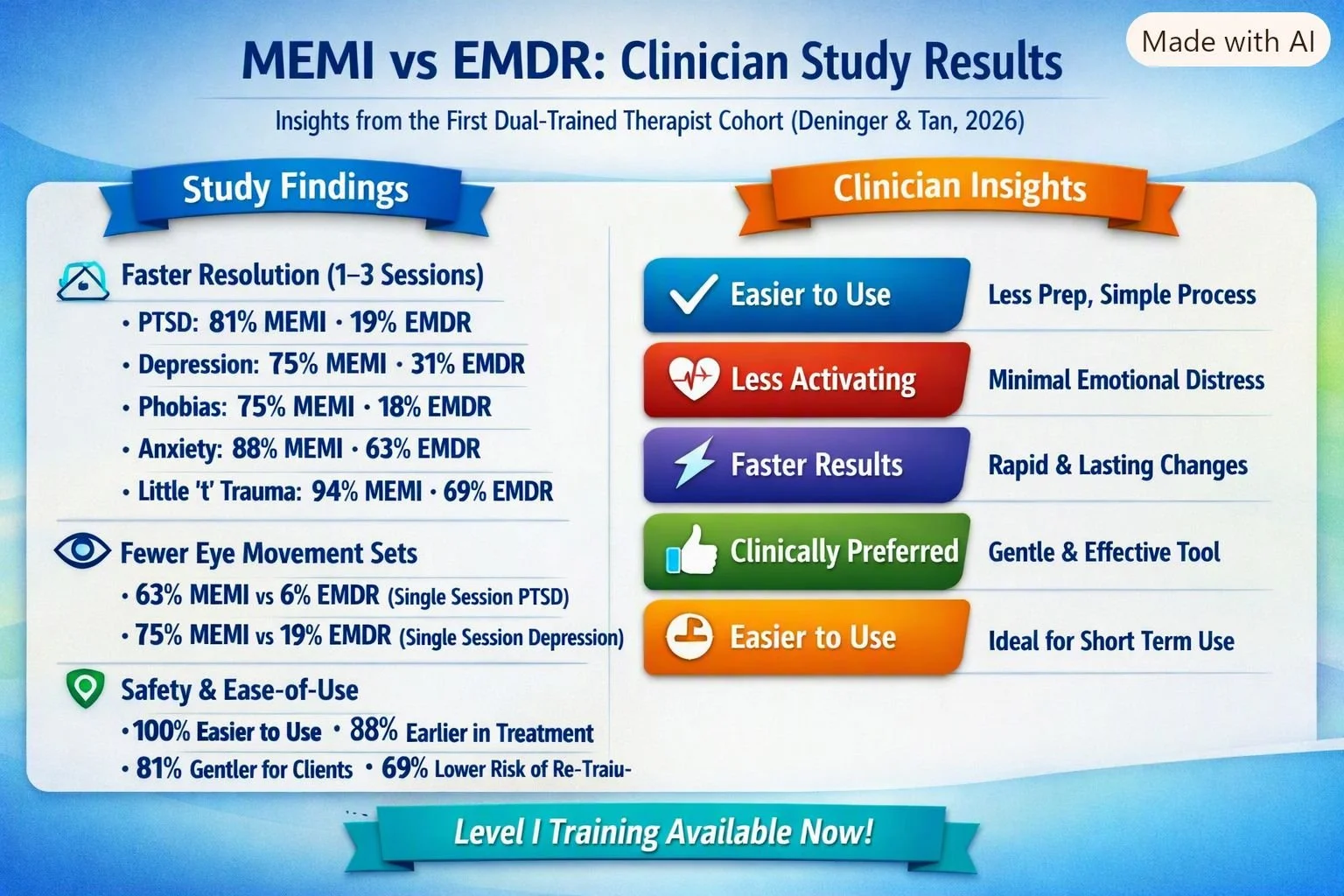
Created by Dr Mike Deninger, MEMI is a brief and gentle therapy that helps people to heal from painful memories. It uses guided eye movements and verbal prompts to permanently reduce the vividness and emotional intensity of those memories in one to three sessions, without the client having to recount the details.

(See my blog post: “What happens during MEMI?”)

  • Quick & cost-effective

    Most trauma therapies require several sessions, which is why clients often drop out. MEMI can give lasting results in just one to three sessions.

  • Content-free

    Most trauma therapies require the client to recount the traumatic experience in detail and sometimes repeatedly, which can be very upsetting for the client and can even retraumatise them.

    In contrast, you don’t need to give me details about what happened for MEMI to still be effective.

  • New perspective

    After MEMI, you’ll still have the memory of the experience, but you’ll no longer have an intense negative reaction when you recall it. It will simply be one of many memories in a rich and full life.

  • More information:

Many of my clients have benefited from MEMI, sometimes after years of struggling and seeing a whole range of mental health professionals.

If you’re curious to try MEMI, get in touch to arrange a session or find out more.

Related Blog Posts